
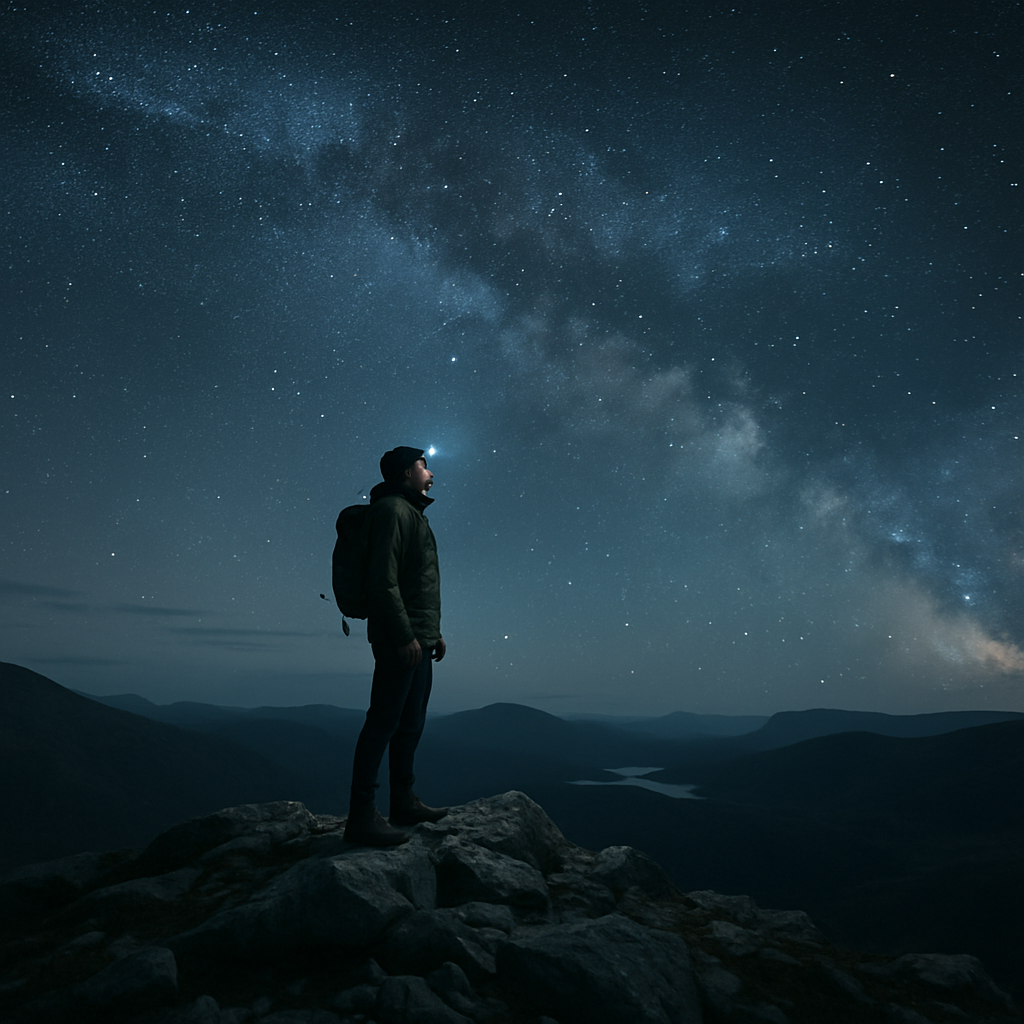
There’s a moment on a night walk in the hills when your head torch battery dies, your compass is somewhere at the bottom of your pack, and the map is frankly useless in the dark. It happens. And if you’ve ever been caught out like that, you’ll know the particular kind of calm that comes from looking up and realising the sky itself is a navigation tool. Learning to navigate using the stars hiking remote routes isn’t just a novelty skill. It’s genuinely practical, deeply satisfying, and older than every bit of kit in your rucksack.
This isn’t about becoming an astronomer. It’s about building a small, reliable toolkit of celestial reference points that work whether you’re crossing the Brecon Beacons at 2am or descending Helvellyn in autumn with cloud cover rolling in. The night sky rewards patience. Once you know what to look for, it becomes surprisingly readable.
Why Celestial Navigation Still Matters for Hikers
Modern navigation is brilliant until it isn’t. Batteries die. Signals drop. A compass can be affected by nearby metal or rock formations with high iron content, which is more common than you’d think in volcanic landscapes like those of the Scottish Highlands or parts of Snowdonia. The British Mountaineering Council consistently emphasises redundancy in navigation skills, meaning you should never rely on a single method. The stars are the ultimate backup. They require no power source, carry no weight, and have never once needed a firmware update.
Beyond the practical argument, there’s something quietly grounding about using the same sky that guided sailors across the North Sea and shepherds across moorland for centuries. It connects you to the landscape in a way that staring at a phone screen simply cannot.
Finding True North Without a Compass
The single most useful skill in celestial navigation is locating Polaris, commonly called the North Star or Pole Star. It sits almost exactly above the Earth’s North Pole, which means it barely moves throughout the night whilst every other star wheels around it. Point yourself at Polaris, and you are facing true north.
Finding it takes about sixty seconds once you know how. Start with the Plough, that distinctive seven-star pan shape also known as Ursa Major. It’s one of the most recognisable formations in the northern sky and visible on most clear nights in the UK. Take the two stars that form the outer edge of the pan’s bowl, these are called the Pointer Stars. Draw an imaginary line through them and extend it upward by roughly five times the distance between those two stars. That bright, steady star at the end of that line is Polaris.
Polaris isn’t the brightest star in the sky, despite what people often assume. It’s moderately bright, but its absolute stillness is what gives it away. Everything else moves. Polaris stays put. Once you’ve genuinely found it a few times on practice nights near home, locating it on the hill becomes second nature.
Key Constellations Worth Learning for UK Night Skies
You don’t need to memorise the whole sky. A handful of reliable formations will serve you well across the British seasons.
The Plough (Ursa Major)
Already mentioned, but worth repeating. It’s your gateway to Polaris and visible year-round from the UK. In spring it rides high overhead; in autumn it dips lower to the north. Learn this one first, full stop.
Cassiopeia
On the opposite side of Polaris from the Plough, Cassiopeia looks like a stretched W or M depending on its position. It’s particularly useful on nights when the Plough is low or partially obscured. Both Cassiopeia and the Plough orbit Polaris, so when one is low, the other is high. Together they give you a year-round route to north.
Orion
Visible in British winter skies from roughly October through March, Orion is unmistakable with his three-star belt. Crucially, Orion’s belt rises almost exactly due east and sets almost exactly due west, regardless of your latitude in the UK. If you watch Orion rising, you know which direction east is. That alone can reorient you quickly on a confusing night.
The Southern Cross? Not Quite.
Worth noting that the Southern Cross, so useful in the southern hemisphere, is not visible from Britain. Stick to the northern formations above.

Using the Stars to Navigate Using the Stars Hiking in Practice
Knowing where north is gets you oriented. But navigation on a real hill requires a bit more method. Here’s a simple approach that works.
First, establish your bearing. If you know you need to walk roughly south-west to reach your campsite, face Polaris (north), then turn 180 degrees for south. South-west is 45 degrees to your right from there. Pick a prominent star in that direction as a temporary waypoint and walk toward it. The key word is temporary. Stars move across the sky as the Earth rotates, so you need to check and update your chosen waypoint roughly every ten to fifteen minutes. Choose a new star in your required bearing and carry on.
The Moon can also help, though less precisely. In its first quarter (right half illuminated), the Moon sets in the west. In its last quarter (left half illuminated), it rises in the east. A full Moon rises in the east at sunset and sets in the west at dawn. Not pinpoint navigation, but enough to confirm you’re heading in roughly the right direction.
Natural Cues to Use Alongside the Night Sky
Stars aren’t always visible. Cloud cover is, shall we say, something of a British speciality. When the sky closes in, lean on other natural cues.
Prevailing winds in the UK blow predominantly from the south-west. If you’ve noted wind direction earlier in the day before cloud came in, that’s a rough directional reference. Vegetation can also help; trees and shrubs on exposed ridges often show wind-shaped growth, leaning away from the south-westerly prevailing direction. Moss grows on all sides of trees in damp UK climates, so the old saying about moss always being on the north side is largely a myth here. But lichen tends to be more abundant on north-facing surfaces where it’s cooler and shadier.
The slope of the land itself is a powerful cue if you’ve studied your map beforehand. Knowing which valley lies to your east, which ridge runs north-south, gives you a framework even in zero visibility. Celestial and natural navigation work best when you’ve done the mental map preparation before it gets dark.
Practice Before You Need It
The worst time to learn any navigation skill is when you actually need it. Spend a few clear nights in your garden or a local park running through the exercises above. Find the Plough. Trace to Polaris. Spot Cassiopeia. Identify Orion’s belt when it’s up. Repeat until it’s muscle memory, not a calculation.
When you’re on a planned night walk or doing a dark-hours section on a long-distance route like the Pennine Way or the West Highland Way, consciously look up and test yourself. Cross-reference what the stars tell you with your compass. Build trust in the method so that if the compass ever fails, the sky is already a familiar friend rather than a confusing stranger.
Combining Star Navigation with Your Existing Skills
Learning to navigate using the stars hiking doesn’t replace map reading, compass work, or terrain association. It sits alongside them as another layer. The most confident navigators I know in the hills are the ones who can triangulate between multiple sources of information simultaneously; the map, the compass, the landscape, the sky. Each confirms or challenges the others. That redundancy is what keeps you safe when things go wrong in the dark.
And there’s a quieter benefit too. Looking up at a clear sky above the Cairngorms or the Pembrokeshire coast path, being able to actually read it rather than just admire it, changes the experience entirely. The hills feel less indifferent when you understand the language they speak at night.
Frequently Asked Questions
How do I find Polaris (the North Star) from the UK?
Locate the Plough constellation, then draw an imaginary line through its two outer Pointer Stars and extend it upward by about five times the gap between them. The moderately bright, perfectly still star at the end of that line is Polaris. It sits almost exactly due north from anywhere in Britain.
Can you navigate using the stars hiking in cloudy UK weather?
When cloud covers the sky, stars aren’t usable, so you need backup natural cues. The UK’s prevailing south-westerly wind direction, vegetation lean on exposed ridges, and terrain features you’ve memorised from the map beforehand all help maintain rough orientation. Celestial navigation works best as one layer in a broader toolkit.
Is star navigation accurate enough for real mountain navigation?
It’s accurate enough to establish cardinal directions and keep you moving in roughly the right bearing, but it won’t give you the pinpoint precision of a good compass bearing on a detailed map. Treat it as a reliable directional tool and orientation check rather than a replacement for detailed navigation on technical terrain.
Which constellations are most useful for hikers in the UK?
The Plough and Cassiopeia are the most consistently useful, both visible year-round from Britain and both pointing you toward Polaris. Orion is excellent in winter months because its belt rises due east and sets due west, giving you a quick east-west reference without any calculation.
Do I need to update my star bearing throughout a night hike?
Yes. Because the Earth rotates, stars appear to move across the sky at roughly one degree every four minutes. When walking by starlight, choose a target star in your required direction and update it every ten to fifteen minutes to account for this drift. Polaris is the exception and never needs updating.