
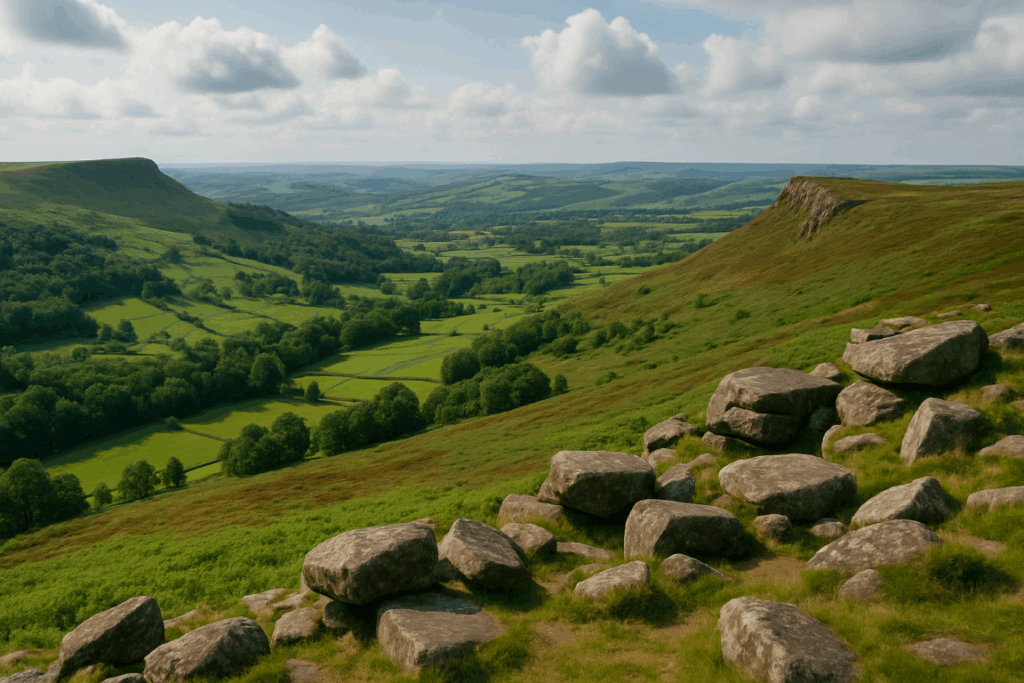

If you’ve spent any time walking in England, you’ll have hit the invisible wall. A public footpath that ends abruptly at a field boundary. A moorland ridge that looks perfectly walkable, no crops, no livestock, no apparent reason for the fence, but crosses private land and is therefore, legally, off limits. Scotland has had the Land Reform (Scotland) Act 2003 for over two decades, giving walkers a presumptive right to roam over most non-enclosed land. England is still catching up, and in 2026 the argument over land access rights for walkers is sharper than it’s been in years.
Where England stands right now
The Countryside and Rights of Way Act 2000 opened up around 865,000 hectares of mountain, moor, heath and down in England and Wales. That sounds like a lot. But it still excludes woodland, farmland, riversides and the majority of the lowland countryside most people actually live near. The result is that England has one of the most restrictive access regimes in Europe for a country with a dense, largely urban population hungry for outdoor space.
Walk anywhere you like in the Lake District above the Open Access boundary and you’re fine. Drop below it into enclosed farmland and you’re back to footpaths only. The practical effect is a patchwork that confuses casual walkers and frustrates experienced ones. I’ve lost count of the number of times I’ve watched a perfectly logical ridge descent blocked because the lower ground simply isn’t covered by CRoW Act access. You pick your way back to a path, often through worse terrain, because the law says so.
What campaigners are actually pushing for
The Ramblers, which is the primary body representing walkers’ interests in Great Britain, has been running its “Right to Roam” campaign with renewed energy. The core ask is an extension of Open Access land to include woodland, rivers, and green lanes, roughly doubling the area where walkers have a legal right to be without a specific right of way beneath their feet.
Guy Shrubsole, whose book Who Owns England? did a lot to push land ownership into public debate, argues that vast areas of England are effectively invisible to ordinary people, owned by a small number of private individuals and institutions, walked over by nobody. The Right to Roam campaign points out that 92% of rivers in England are inaccessible to the public, and that woodland, the most requested habitat for expanded access in surveys of walkers, remains almost entirely private in law.
For walkers, the practical ask isn’t about trespassing on farmland or marching through someone’s garden. It’s about having the same freedom that hill-goers in Scotland or Scandinavia take for granted: the ability to walk through a wood, follow a riverbank, or cross open hillside without constantly checking whether a map shows a thin dotted line beneath your boots.
What landowners argue, and where they have a point
The Country Land and Business Association (CLA), which represents many rural landowners and farmers, has consistently resisted calls for extended access. Their objections fall into a few categories: liability, land management, and the specific needs of food production.
Liability is the one that gets raised most often. If a walker is injured on private land under an extended access regime, who is responsible? The CRoW Act included provisions limiting landowner liability for access land, but extending those provisions to more land types requires careful drafting. The CLA argues it hasn’t seen convincing assurance that farmers and landowners would be adequately protected.
On farmland specifically, they have a reasonable case. Arable fields aren’t suitable for casual walking during the growing season, and the right to roam in Scotland is already subject to a sensible list of exclusions, including crops, and areas where access would interfere with land management. A blanket extension without those kinds of conditions would genuinely cause problems. The argument becomes less convincing when applied to ancient woodland that hasn’t been actively managed for decades, or to riverbanks where the only real objection is that the land is private.
Some landowners also raise concerns about antisocial behaviour, litter, dogs off leads around livestock, fires. These are real problems, and anyone who’s picked up rubbish left on a fell knows that not every walker treats the countryside with respect. But the evidence from Scotland and from existing Open Access land in England doesn’t suggest that expanded rights lead to a collapse in land management. Most people who want to walk through a wood just want to walk through a wood.
The political situation in 2026
The current government made sympathetic noises about access reform in its early months, and there have been consultations on extending access to rivers and woodland. As of 2026, no legislation has passed. The political difficulty is familiar: walkers are numerous but diffuse, while landowners, particularly large estate owners, have concentrated lobbying power and deep connections in parliament.
The Environment Act 2021 created some new mechanisms around nature recovery and land use, and there’s ongoing discussion about how any expanded access regime might interact with agri-environment schemes under post-Brexit agricultural policy. Whether any of that translates into a meaningful extension of land access rights for walkers in England remains, in honest terms, uncertain.
What’s shifted is the public mood. The pandemic pushed millions of people outdoors who had never thought much about footpaths or access land before, and many of them encountered the same invisible walls I described at the start. That constituency is larger now than it was when the CRoW Act passed.
What it would actually mean on the ground
For a walker planning a day out, extended access rights would mean route flexibility that currently only exists on designated Open Access land or in Scotland. It would mean being able to follow a river upstream rather than losing it when the footpath veers away. It would mean woodland walks that don’t require finding a Forestry England site or a permissive path. For those of us who spend time reading contour lines and planning routes, it would mean map-reading becoming a tool for possibility rather than a search for permissions.
It would also have implications for how people use the rights they already have. Understanding places like Dartmoor, which has its own ancient rights of access to open moorland, gives a useful preview of what expanded access might look like in practice. Dartmoor walkers largely treat the moor with care. The apocalyptic predictions that open access leads to ecological destruction haven’t materialised there.
For those of us who hike regularly, the honest answer is that expanded access would remove a lot of small frustrations rather than transform what’s possible. The best walking in England is already accessible. What changes with broader land access rights is the middle ground, the millions of acres of ordinary countryside that are currently experienced only from a lane or a right of way, never from within.
I’d argue that’s worth fighting for. The countryside isn’t a museum to be looked at from designated paths. It’s a living landscape that people need to be part of if they’re going to care about it, protect it, and push back when it’s threatened. Keeping walkers at arm’s length doesn’t preserve the land, it just keeps it invisible. And invisible things are very easy to lose.
If you’re interested in the broader question of how walking interacts with the working countryside, the piece on hill farming and the upland landscape is worth your time, the tension between access and land use is something that goes back a long way, and understanding it makes you a better walker.
Leave a Reply